

Product Informations: Quinowin Suspension
Information About Quinowin Suspension
In Treatment of Amoebiasis Amoebiasis is an infection caused by a parasite named Entamoeba histolytica. It is often transmitted through contaminated food or water. Symptoms associated with Amoebiasis are not very common. However, in some cases where symptoms do occur, the severity may range from mild diarrhea to blood in stools (dysentery), intestinal inflammation, and pus in the liver (liver abscess). Quinowin Suspension is given along with other medicines for the treatment of the above manifestations. Awareness of the quality of food, water, and sanitation conditions can help to prevent an infection. In Treatment of Malaria Quinowin Suspension is used to treat malaria, a serious or life-threatening illness that is spread by a parasite that enters the human body by the bite of infected mosquitoes. It kills the infection causing parasite and stops further spread of the infection. Take it only as prescribed and refrain from taking any other medicines along with this medicine (unless advised by the doctor) as they may affect the absorption of this medicine. Do not use this medicine for treating any other condition without consulting your doctor.
Benefits
Description
How to use
Common Side Effect
- Photosensitivity
- Rash
- Headache
- Dizziness
- Vomiting
- Nausea
- Stomach pain
- Loss of appetite
- Diarrhea
Safety Advice
Quinowin Suspension is safe to use in patients with kidney disease. No dose adjustment of Quinowin Suspension is recommended. However, prolonged use may impact kidney function in your child. The use of this medicine is not recommended in children with severe kidney disease.
Quinowin Suspension should be used with caution in patients with liver disease. Dose adjustment of Quinowin Suspension may be needed. Please consult your doctor.
Missed dose
How Its Works
Fact Box
Question and Answer
- Q. Q. What lab test can be done to identify malaria in my child??
Ans: Your child needs to undergo laboratory tests such as complete blood count, blood smear test, or malaria rapid diagnostic test for the diagnosis of malaria. - Q. Q. My child is having a genetic deficiency of the G-6-PD enzyme. Is it safe to give Quinowin Suspension??
Ans: Children with G-6-PD enzyme deficiency should avoid Quinowin Suspension. The deficiency of this enzyme in the body can lead to the breaking of blood cells, resulting in severe anemia. It is advised that you get your child’s enzyme level evaluated before starting the course of treatment. - Q. Q. Can other medicines be given at the same time as Quinowin Suspension??
Ans: Quinowin Suspension may interact with other medicines or substances. Therefore, it would be advised to inform your doctor about any other medicines your child is taking before starting Quinowin Suspension. - Q. Q. How should Quinowin Suspension be stored??
Ans: Quinowin Suspension should be stored at room temperature in a dry place, away from direct heat and light. Also, keep all medicines out of the reach and sight of children to avoid any mishap. - Q. Q. What is Quinowin Suspension and what it is used for??
Ans: Quinowin Suspension is an anti-malarial medicine that is used for the treatment and prevention of malaria. - Q. Q. How long does it take for malaria symptoms to show??
Ans: Symptoms of malaria can develop as quickly as 7 days after you are bitten by an infected mosquito. Usually, the symptoms may take up to 7 to 18 days to appear (incubation periods) from the day of the infection. Initial symptoms of malaria are flu-like which include feeling hot and shivery, fever, muscle pains, vomiting, headaches, and diarrhea. - Q. Q. Is it safe to use Quinowin Suspension for a long period of time??
Ans: If your doctor has prescribed you Quinowin Suspension for a longer period of time, you should get your eyes checked regularly. This is because chloroquine present in this medicine might cause blurred vision, difficulty reading (due to words disappearing), and a rare eye condition called retinopathy if taken for a longer period of time. - Q. Q. Who should not use Quinowin Suspension??
Ans: Inform your doctor if you have psoriasis before taking Quinowin Suspension since it may make your condition worse. - Q. Q. What are the side effects of Quinowin Suspension??
Ans: Some of the most common side effects of this medicine are stomach pain, nausea, vomiting, and headache. These side effects can often be reduced by taking the medicine with food. - Q. Q. Can chloroquine cure coronavirus (COVID-19)??
Ans: There is not enough medical data to prove that chloroquine is effective in treating COVID-19. Therefore it is advisable not to take Quinowin Suspension without consulting your doctor for treating COVID-19. - Q. Q. Can I take antacids along with Quinowin Suspension??
Ans: If you take an antacid, give a gap of at least 4 hours between the two medications. - Q. Q. What is the difference between hydroxychloroquine and chloroquine??
Ans: Hydroxychloroquine and chloroquine were both first approved for malaria. However, chloroquine tends to cause many more side effects than hydroxychloroquine. As a result, hydroxychloroquine is more commonly used today. Hydroxychloroquine is also approved to treat rheumatoid arthritis and lupus, while chloroquine is not. - Q. Q. How can you prevent yourself from getting malaria??
Ans: Malaria can be prevented by taking certain precautionary steps like covering your arms and legs to prevent mosquito bites, using a mosquito net and insect repellent. Check with your doctor whether you need to take malaria prevention tablets. If you do, make sure you take the right antimalarial tablets at the right dose and finish the proper course of treatment.
Marketer details
FDC Ltd | B-8, MIDC Area, Waluj - 431 136, Dist. Aurangabad, Maharashtra
Alternatives and Substitutes
1 AL AX 5mg/75mg Capsule
Marketer/Manufacturer: Abbott || ₹14.5/tablet (25% cheaper)
Customer Reviews
No customer reviews yet.
References
FDA approved prescribing information. Levocitrizine; 1995 [revised May 2007]. [Accessed 01 Apr. 2019] (online) Available from: Read More
European Medicne Agency. Revised assessment report: Ambroxol and bromhexine containing medicinal products. 2015. [Accessed 01 Apr. 2019] (online) Available from: Read More
ScienceDirect. Ambroxol. [Accessed 01 Apr. 2019] (online) Available from: Read More
Levocitrizine. Slough, Berkshire: UCB Pharma Limited; 2007 [revised 27 Mar. 2019]. [Accessed 01 Apr. 2019] (online) Available from: Read More
View all substitutes
Total items: (9)
| QTY | Stock Status | Brand Name | Generic Name | Strength | Form | Size | MRP | Discount | Net Cost | MFR | Type | Add Cart |
|---|---|---|---|---|---|---|---|---|---|---|---|---|
|
|
Jagquin 50mg Syrup | Chloroquine (50mg) | 50mg | Syrup | bottle of 60 ml Syrup | ₹12.41 | ₹2.48 | ₹9.93 | Jags... | RX | ||
|
|
Paraquin 50mg Suspension | Chloroquine (50mg) | 50mg | Suspension | bottle of 60 ml Suspension | ₹16.45 | ₹3.29 | ₹13.16 | Shre... | RX | ||
|
|
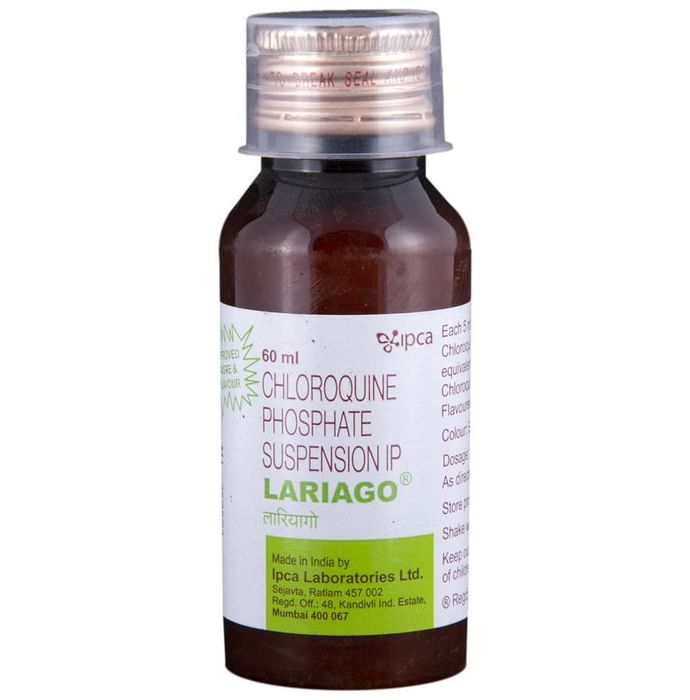
Lariago Suspension | Chloroquine (50mg) | 50mg | Suspension | bottle of 60 ml Suspension | ₹18.90 | ₹3.78 | ₹15.12 | Ipca... | RX | ||
|
|
Bitaquine 50mg Suspension | Chloroquine (50mg) | 50mg | Suspension | bottle of 60 ml Suspension | ₹15.37 | ₹3.07 | ₹12.30 | Bomb... | RX | ||
|
|
Malarbin 50mg Suspension | Chloroquine (50mg) | 50mg | Suspension | bottle of 60 ml Suspension | ₹14.88 | ₹14.88 | ₹0.00 | Acro... | RX | ||
|
|
Bitaquine 50mg Drop | Chloroquine (50mg) | 50mg | Drop | packet of 10 ml Drop | ₹17.16 | ₹17.16 | ₹0.00 | Bomb... | RX | ||
|
|
Sequin 50mg Suspension | Chloroquine (50mg) | 50mg | Suspension | bottle of 60 ml Suspension | ₹14.63 | ₹14.63 | ₹0.00 | Mane... | RX | ||
|
|
Lariquin 50mg Suspension | Chloroquine (50mg) | 50mg | Suspension | bottle of 60 ml Suspension | ₹16.22 | ₹16.22 | ₹0.00 | Them... | RX | ||
|
|
Nivaquine P 50mg Suspension | Chloroquine (50mg) | 50mg | Suspension | bottle of 60 ml Suspension | ₹16.80 | ₹16.80 | ₹0.00 | Abbo... | RX |
Available options.
Same salt composition: Chloroquine (50mg)
- Sale
- Sale
- Sale
- Sale
Test Buy medical disposable face mask
to protect your loved ones


We want to give you 10% discount for your first order,
Use discount code at checkout


We want to give you 10% discount for your first order,
Use discount code at checkout